
Overview
The purpose of this article is to explain how to create the Sage 100 user for our sync tool with the appropriate permissions.
Creating the User Role
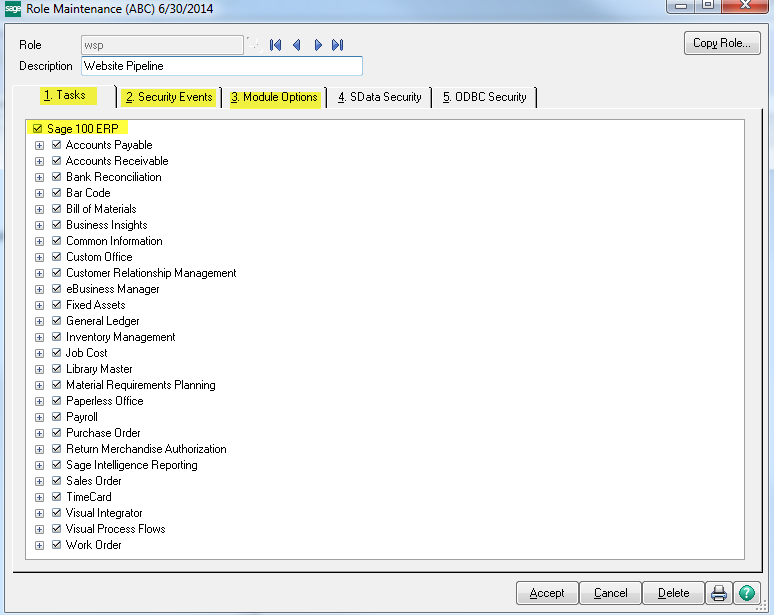
To create the role for the user, go into Sage and under role maintenance, create a new role for WSP. It should have, at minimum, the following permissions selected:
-
- For Tasks: Every option under Accounts Receivable, Common Information, Inventory Management, and Sales Order are checked.
- For Security events: Every option under Accounts Receivable, Common Information, Inventory Management, and Sales Order are checked.
- For Module options: Every option under Accounts Receivable, Common Information, Inventory Management, and Sales Order are checked.
- For SData Security (if it is used): Every option under Accounts Receivable, Common Information, Inventory Management, and Sales Order are checked.
- For ODBC Security (if it is used): Every option under Accounts Receivable, Common Information, Inventory Management, and Sales Order are checked.
Creating the User
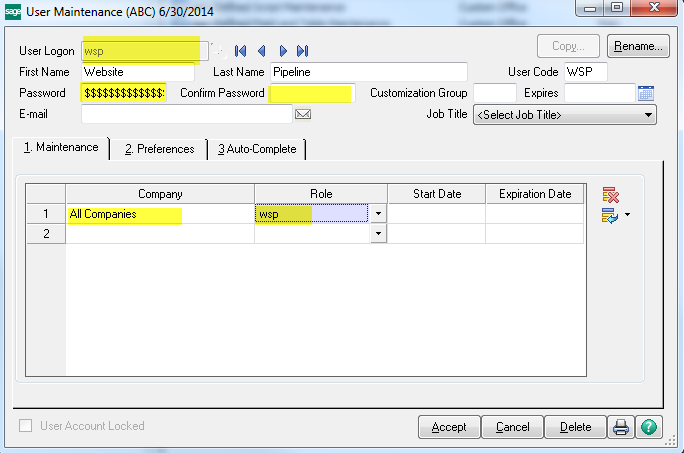
Once this is done, create a new user by going to User Maintenance and creating a new user and password, using the role from above. The password for this used should be at least 25 characters long.
Verify External Access
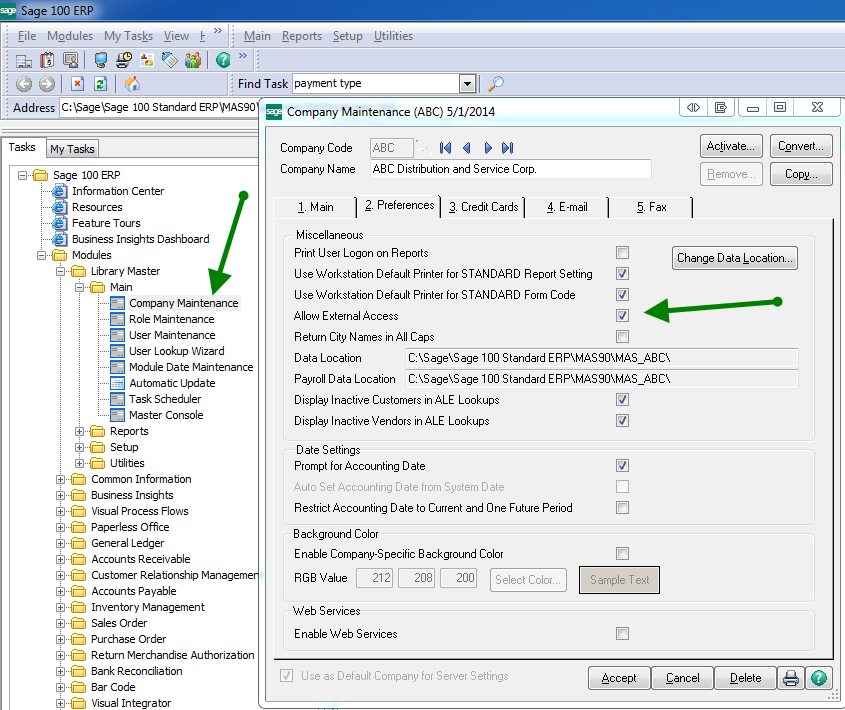
Verify that “Allow External Access” is checked under Company Maintenance for the Company Code(s) that will be used by the tool.
Sage 100 Premium: Creating the SQL Server Login
If you use Sage 100 Premium (SQL Server), the ERP Sync Tool reads data directly from your Sage SQL databases. It needs its own SQL Server login in addition to the Sage 100 user above.
- In SQL Server Management Studio, create a new login under Security > Logins:
- Login name:
CIMSync. If you already have a login for CIMcloud (for exampleWSPDataSync), you don’t need to rename it. - Authentication: SQL Server authentication. The SQL Server instance must allow “SQL Server and Windows Authentication mode.”
- Password: at least 25 characters, or the value CIMcloud gives you through a secure link.
- Uncheck Enforce password expiration. If the password expires, the sync stops until the password is reset.
- Login name:
- Under User Mapping, give the login the db_datareader role on:
MAS_SYSTEM- the company database for each company code the sync uses (
MAS_+ company code, e.g.MAS_ABC)
- Send the password to CIMcloud securely through https://sendsecret.cimcloud.com/. Do not post it in a task or email it in plain text.